
Why 4-Way Shuttle is Winning the Pallet High-Density Game in the Warehouse
Why 4-Way Shuttle is Winning the Pallet High-Density Game in the Warehouse
Four-way shuttle market penetration surged thirty-fold over five years as traditional crane adoption dropped.
The global material handling and automated logistics sector is undergoing a massive structural transformation. Driven by surging real estate costs, severe labor shortages, and the aggressive e-commerce velocity requirements of modern supply chains, the global Automated Storage and Retrieval Systems (AS/RS) market is expanding rapidly. Just five years ago, an overwhelming 99% of all pallet AS/RS projects utilized traditional stacker cranes. Today, that installation rate has dropped to approximately 70%, meaning 4-way shuttle technology has achieved a remarkable 30-fold increase in market penetration in a matter of five years.
As enterprise operators design next-generation fulfillment centers, the core architectural debate increasingly centers on this rapid shift from conventional stacker crane AS/RS to modern, distributed 4-Way Shuttle Systems. While stacker cranes historically dominated high-bay logistics, this clear shift demonstrates that the industry is recognizing a new reality where distributed intelligence and structural agility systematically redefine the rules of high-density pallet storage.
1. Technical Architectural Differences
Decentralized multi-directional shuttle networks outperform single-point-of-failure rigid linear crane tracks.
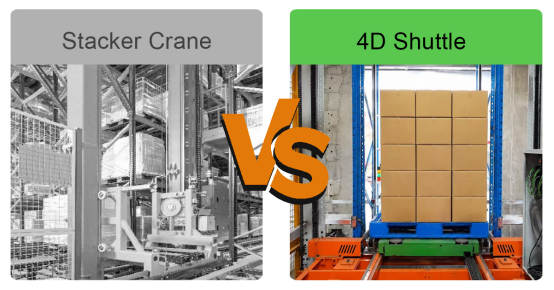
To understand why the market is pivoting, one must examine the underlying mechanics of both automation philosophies. Stacker crane AS/RS operates on a rigid, single-point-of-failure model where systems feature a massive vertical mast traveling along a fixed floor rail and stabilized by a top guide rail. A carriage moves vertically along the mast, equipped with telescopic forks to deposit and retrieve pallets. Because the crane is physically confined to a single linear path, a standard single-deep or double-deep setup means one machine handles an entire dedicated aisle.
Conversely, Rainbow Dynamics designs 4-way shuttle systems that utilize a decentralized fleet of autonomous robotic vehicles traveling on a grid network built directly into the racking infrastructure. These rovers change directions orthogonally – moving both longitudinally down aisles and latitudinally across cross-aisles without physically turning. They utilize specialized vertical lifts to change levels within the rack matrix, effectively decoupling horizontal transport from vertical transfer and shifting the facility from a rigid mechanical system to a dynamic, scalable grid network.
Here are the three core technical comparisons between 4-way shuttles and traditional AS/RS stacker cranes:
Kinematic Footprint and Redundancy Architecture: Traditional AS/RS stacker cranes operate as a Single Point of Failure (SPOF). They rely on high-torque single or double mast traction drives; if a single drive motor faults, 100% of the stock in that aisle becomes completely stranded. Conversely, a 4-way shuttle infrastructure utilizes a decentralized swarm fleet routing autonomously across orthogonal X/Y track axes. If an individual bot encounters an operational fault, the Warehouse Control System (WCS) orchestration layer dynamically recalculates pathfinding loops and reroutes adjacent shuttles via parallel transfer lanes, preserving fleet availability and system uptime.
Structural Load Limits and Civil Engineering Constraints: Stacker cranes remain highly effective for heavy payload handling (often exceeding 2,000 kg per pallet) and extreme vertical scaling up to 45 meters. However, their massive dynamic wheel loads and intense top-guide rail bending moments exert severe localized mechanical stresses, demanding heavily reinforced concrete foundations. 4-way shuttle systems distribute fleet weight evenly across a high-density racking grid, capping out at lower vertical profiles (typically under 25 meters) and maximum payloads of 1,200 to 1,500 kg. This allows 4-way automation to integrate into standard warehouse spaces without requiring complex structural floor remediation or specialized deep-slab pouring.
Kinematic Tolerances and Installation Precision: Stacker cranes rely on long-range laser barcode positioning and absolute encoders to maintain a +/-2mm positioning accuracy across massive vertical distances. 4-way shuttles operate on tight, hyper-precise track gauges embedded right into the racking structure. This setup demands stringent geometric installation compliance under European standard EN 15620 (Class 400). Transverse rail parallelism (track gauge width) must be held within a razor-thin +/-2.0mm tolerance, track joint vertical step-offs must not exceed 0.5mm, and total structural plumbness must match an under H/500 baseline to prevent wheel slippage or onboard IMU (Inertial Measurement Unit) sensor drift.
2. Maximizing Density and Spatial Footprint Utilization
Modular shuttle matrices eliminate operating aisles completely to maximize lower-envelope warehouse cube utilization.
Maximized volumetric efficiency is a core requirement for modern warehouse design, but the two systems approach density with fundamentally different structural configurations. Stacker cranes excel at extreme vertical heights, where leading manufacturers like Daifuku, Dematic, SSI SCHAEFER, and Swisslog frequently engineer crane systems capable of reaching heights of 30 to 45 meters. For high-bay warehouses where the building envelope can expand vertically, stacker cranes provide massive storage density, though they require broad, structurally demanding operational aisles to accommodate the crane’s mast profile, anti-sway clearances, and horizontal travel tolerances.
Conversely, 4-way shuttle systems optimize for extreme density within lower to medium height envelopes, typically up to 25 meters. Providers in this space engineer systems that eliminate traditional operating aisles almost entirely. By utilizing a continuous matrix grid, deep-lane storage configurations of 4 to 12 pallets deep can be achieved seamlessly. Innovative robotic solution developers like Movu Robotics (with their advanced atlas system), Moffett Automated Storage (featuring their free-roaming Taxi rovers), and Rainbow Dynamics design these systems to significantly reduce the required floor footprint compared to conventional selective layouts, allowing operators to maximize every cubic meter in irregular or restricted structural footprints.
3. Strategic Go-To-Market Alignment and Sourcing Dynamics
Sourcing models dictate long-term system cost efficiency and the quality of localized engineering support.
The ownership and distribution strategies of major shuttle providers create vastly different commercial outcomes for end-users. For instance, Movu Robotics is owned by the stow Group, a major manufacturing entity, which creates a natural hardware tie-in that frequently leads to higher overall structural and system costs for customers. Meanwhile, Moffett Automated Storage operates through a strong strategic partnership with SSI SCHAEFER, allowing for reliable ecosystem alignment.
Standing out in this landscape, Rainbow Dynamics functions on an integrator-only business model. By vowing never to compete with its own channel by going direct, the company works exclusively through specialized integration partners – such as Alliance Material Handling, Greenspace, and Bradford – to deliver high-touch, localized engineering services and ongoing operational support. Furthermore, because Rainbow Dynamics remains strictly racking-agnostic, operators and their integration partners gain substantial cost benefits by choosing the most competitive structural steel solutions in their respective regions.
Operating globally across core markets in the United States, United Kingdom, Europe, and Japan, Rainbow Dynamics has deployed high-density AS/RS solutions for leading e-commerce players, tier-one global brands like Bosch, and elite third-party logistics (3PL) providers including Nippon Express.
To deliver these localized cost and execution benefits globally, Rainbow Dynamics collaborates with leading regional racking companies that possess specialized 4-way shuttle manufacturing capabilities. In the United States, the company works directly with Engineered Products and Stakkd to deliver robust, automated matrices. For European deployments, a partnership with Polypal ensures adherence to stringent regional structural standards, while in the Asian market, collaboration with Luckyrock provides localized manufacturing advantages.
Crucially, because a 4-way shuttle matrix demands a much lower tolerance for alignments compared to traditional storage – requiring millimeter-precise X-Y perpendicular track intersections, rigid plumbness to prevent cumulative pitch errors, and custom-machined rail connections – these specialized partners are essential. They transform basic warehouse steel into a high-precision structural machine frame, allowing Rainbow Dynamics integration partners to optimize customer capital expenditures without sacrificing robotic performance.
4. Dynamic Scalability and System Redundancy
Flexible shuttle fleets scale throughput easily and provide continuous operational uptime through redundancy.
Evaluating throughput requires examining the operational difference between a single massive mechanical asset and a distributed swarm network. In a stacker crane AS/RS layout, the throughput of a specific aisle is strictly governed by the kinematics of that single crane. If an aisle experiences a spike in demand, the crane becomes a localized bottleneck; more critically, if the crane experiences a mechanical or electrical fault, the entire aisle – and 100% of the inventory stored within it – becomes completely inaccessible until maintenance teams resolve the issue.
In contrast, 4-way shuttle networks treat throughput as a dynamically scalable variable. If a facility requires higher picks per hour, the operator can add more shuttle units to the existing rack matrix without altering the physical building infrastructure. Furthermore, the modern architecture deployed by Rainbow Dynamics features built-in operational redundancy. If an individual shuttle requires maintenance, it can be isolated on a service level while other units take over its tasks. Software systems automatically redirect alternative shuttles and vertical lifts to ensure inventory remains continuously available, entirely eliminating single points of failures.
5. The Cold Storage Advantage
Deep-lane shuttle configurations slash sub-zero refrigeration volumes and protect technicians via remote ground-level recovery.
The economic and operational advantages of 4-way shuttles become most pronounced within temperature-controlled and deep-freeze environments. Cold storage operators face severe cost pressures due to the massive energy required to maintain sub-zero temperatures, making every cubic meter of unutilized air a financial waste. Stacker cranes require significant clearance spaces at the top, bottom, and sides of the aisles to maneuver safely, resulting in costly dead-volume volumetric footprints that contain no product. 4-way shuttles pack pallets tightly in deep-lane configurations, minimizing the total volume of air that needs to be actively cooled.
Furthermore, mechanical mass plays a significant role in energy efficiency; stacker cranes must accelerate and decelerate a massive structural mast weighing several tons to move a single 1,000 kg pallet, yielding an inefficient dead-load to live-load ratio that causes severe thermodynamic inefficiencies. 4-way shuttles, such as those engineered by Movu Robotics, Moffett Automated Storage, and Rainbow Dynamics, weigh significantly less than a multi-ton crane carriage. This structural weight reduction vastly minimizes the kinetic energy required per pallet shift, allowing the system to fully capitalize on ultra-efficient regenerative braking profiles.
Finally, fixing a stacker crane at a height of 35 meters in a -25C environment presents severe safety challenges, whereas 4-way shuttles allow automated recovery scripts to pull a malfunctioning rover out of the rack matrix to a heated, ambient ground-level maintenance bay. These rovers execute automated ohmic heating and condensation prevention cycles during transit to ensure that moisture does not freeze or damage internal electronic components when transitioning between different temperature zones.
6. Financial Profile: CAPEX, OPEX, and ROI
Agile shuttle investments offer flexible modular capital scaling and significantly lower lifecycle operational expenditures.
The financial profiles of these technologies differ significantly across project lifecycles. For large-scale, greenfield high-bay developments exceeding 30 meters in height, stacker cranes can demonstrate a lower cost-per-pallet position because the racking remains basic while a few expensive cranes cover massive vertical storage fields. For installations under 25 meters, however, the heavy upfront engineering costs and precision rail alignment of traditional AS/RS cranes can make them cost-prohibitive.
Additionally, the immense wheel loads of high-bay cranes cause high dynamic floor slab deflection and intense punching shear stress, which forces operators into expensive civil engineering modifications. 4-way shuttle systems offer a more modular capital expenditure (CAPEX) model, allowing operators to deploy an initial fleet of shuttles to meet current demand and purchase additional units as business volumes scale over time. From an operational expenditure (OPEX) perspective, the lower power requirements of lightweight shuttles, combined with the ease of ground-level maintenance, dramatically lower long-term ownership costs and accelerate the timeline to achieve a positive return on investment.
7. Strategic Integration and Ecosystem Synthesis
Open-architecture software layers seamlessly synchronize autonomous shuttle fleets with modern warehouse orchestration systems.
A successful AS/RS installation relies heavily on the integration of Warehouse Management Systems (WMS) and Warehouse Control Systems (WCS). Large system integrators like Knapp, TGW Logistics Group, Kardex, and Murata Machinery focus extensively on the software stack required to orchestrate these automated movements. When deploying a 4-way shuttle framework, the WCS orchestration layer handles rapid data exchange via API-driven inter-process communication (IPC) to coordinate movements down to the millisecond.
The software utilizes advanced heuristic pathfinding algorithms to chart the fastest, lowest-energy routes for the vehicles across a shared matrix. Simultaneously, it runs real-world dynamic fleet deadlock resolution logic at X-Y rail intersections to prevent vehicles from blocking each other’s paths, while continuously balancing the charging states of cold-resilient LiFePO4 supercapacitors. Emerging modular solutions from specialized robotics providers like Rainbow Dynamics are designed to integrate cleanly with these open-architecture WCS platforms via standardized APIs, enabling agile deployment timelines and simplifying integration for system integrators.
Ultimately, while the choice between these two structural paradigms depends on facility height constraints, the modern supply chain demand for greater flexibility, resilience against single points of failure, and extreme thermal efficiency in cold storage ensures the 4-way shuttle is decisively winning the high-density pallet game.