
Rainbow Dynamics Partners With Valor to Transform Warehouse Automation
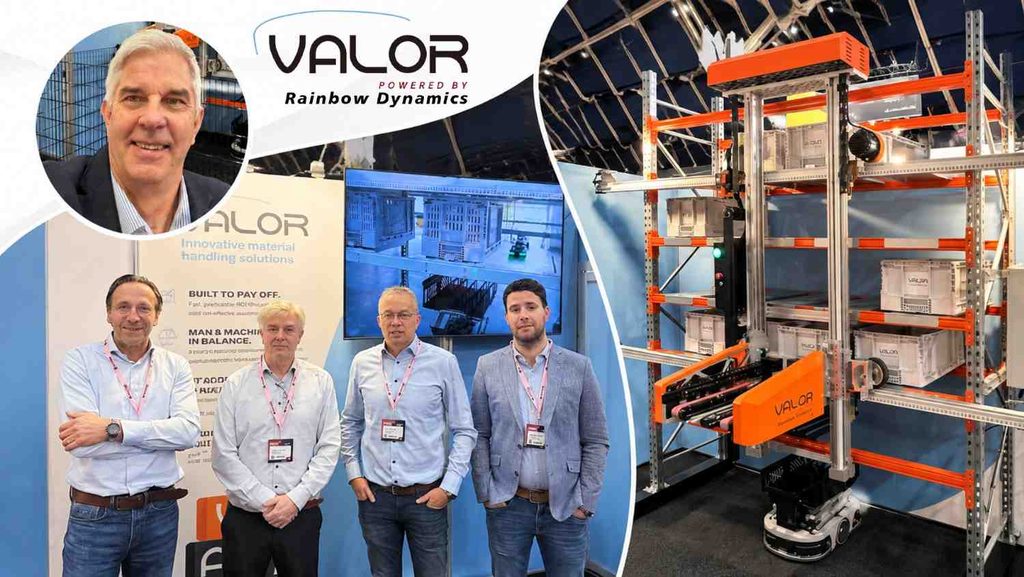
| Overview: Rainbow Dynamics has partnered with Valor Material Handling to integrate RackBot goods-to-person robotics into its warehouse automation portfolio. Combining robotic tote retrieval, high-density storage, conveyor systems, and Qliqflow software, the partnership helps warehouses reduce picking travel time, maximize storage capacity, and scale operations efficiently. |
At Logistica Next 2026, held from 3 to 5 November at Jaarbeurs in Utrecht, the Netherlands, Rainbow Dynamics and Valor Material Handling announced their strategic partnership to advance integrated warehouse automation. The collaboration brings Rainbow Dynamics’ RackBot goods-to-person robotics into Valor’s warehouse automation portfolio, combining automated storage and retrieval with intralogistics expertise, conveyor systems, and Qliqflow software.
By combining RackBot’s robotic tote retrieval capabilities with Valor’s experience in material handling and warehouse system integration, the partnership aims to help warehouse operators improve picking workflows, optimize storage utilization, and develop scalable automation solutions.
The collaboration also follows Rainbow Dynamics’ 100% indirect go-to-market strategy and integrator-only distribution model. Rainbow Dynamics works exclusively through system integration partners, supporting them across sales, installation, commissioning, and services rather than competing with them for end customers.
What Makes Our Shared Engineering Mindset Such a Perfect Fit for Warehouses?
Every warehouse facility operates with its own unique requirements, but many face similar operational challenges. Limited floor space, increasing labour costs, high order volumes, and seasonal demand fluctuations can put pressure on existing picking and storage systems.
Valor Material Handling has experience addressing these challenges through person-to-goods systems, conveyor solutions, sorting equipment, and its Qliqflow software platform, which supports internal material movement and warehouse operations.
However, conventional picking processes can become less efficient as order volumes increase. Valor recognized the value of adding a dedicated goods-to-person solution to its portfolio. Rather than developing an entirely new robotics platform, the company looked for an established technology partner with the engineering expertise and integration capabilities required for warehouse automation projects.
This is where Rainbow Dynamics comes in. We develop automated storage and retrieval systems around practical engineering, modular architecture, and efficient operation. Our technology portfolio covers both pallet and tote handling, including 4D Pallet Shuttle AS/RS and RackBot goods-to-person robotics.
Both companies share an approach focused on reliable equipment, straightforward integration, and solutions that address specific operational requirements without adding unnecessary complexity.
How is RackBot Helping Valor Level Up Their Portfolio for Modern Warehouses?
This partnership brings our RackBot system – a compact, high-efficiency robotic storage solution designed to handle tote movement across warehouse inventory networks – into Valor’s equipment portfolio.
Combining our technology with Valor’s system design gives warehouse operators several practical advantages.
Reducing Picking Travel Time
RackBot retrieves storage totes and delivers them directly to fixed picking stations. Instead of travelling between storage locations, warehouse employees can focus on picking and order fulfilment.
Reducing unnecessary travel can improve picking efficiency, particularly in facilities handling high order volumes or operating with large inventory ranges.
Maximizing Vertical Storage Space
RackBot uses vertical storage space to increase inventory density within the available warehouse footprint. This allows operators to make better use of existing floor space while keeping stored goods accessible through automated retrieval. For warehouses facing space constraints or considering facility expansion, improving storage density can be an important part of the automation investment.
Scalable Modular Design
Warehouse requirements change as businesses grow. An automation system that works today must also accommodate future changes in inventory levels and order volumes. RackBot uses a modular design that allows operators to start with a system suited to their current requirements and expand as operational demand increases. This gives warehouse owners greater flexibility when planning automation investments.
Racking-Agnostic Flexibility
Warehouse automation should fit the requirements of the facility rather than restrict the choice of infrastructure suppliers. Rainbow Dynamics does not manufacture or sell racking and is not tied to a specific racking supplier. Our technology is designed to work with standard racking configurations, subject to technical requirements.
This gives system integrators the flexibility to work with their preferred racking partners when designing warehouse solutions, rather than being restricted to a proprietary racking offering.
Seamless System Integration
A robotic storage system needs to work alongside the wider warehouse infrastructure. Conveyor systems, warehouse execution software, and existing ERP platforms all play a role in coordinating inventory movement and order fulfilment.
Valor integrates RackBot with its material handling systems and Qliqflow software to provide a coordinated warehouse automation solution. Rainbow Dynamics’ modular software architecture is also designed to integrate with system integrators’ WES platforms and customer ERP systems, allowing automation technology to fit into broader warehouse operations.
Delivering Maximum Return on Investment for Warehouses
Automation works best when it serves a clear financial purpose, not just because the technology looks impressive. Beyond the initial equipment cost, warehouse owners need to consider picking productivity, storage density, labour requirements, system uptime, maintenance, and the ability to accommodate future growth.
The objective is not simply to automate individual tasks. It is to improve the overall performance of the warehouse while keeping operating and ownership costs under control.
By combining RackBot with Valor’s conveyor and material handling systems, the partnership provides warehouse operators with an integrated approach to goods-to-person picking and internal material movement. For system integrators, Rainbow Dynamics also maintains a clear channel policy. We follow a 100% indirect go-to-market strategy, meaning our integration partners retain ownership of their customer relationships. We support them in winning projects, installing systems, commissioning equipment, and providing ongoing services.
Maintenance and Long-Term Service Support
The performance of an automated warehouse depends on more than its initial installation. Equipment availability, access to spare parts, and timely maintenance all influence long-term operational performance.
Rainbow Dynamics works with its system integration partners to support maintenance requirements and provide spare parts for their end customers. This allows integrators to offer continued service support while maintaining their customer relationships.
For warehouse operators, this support is an important consideration when evaluating automation suppliers. The long-term value of a system depends not only on its initial capabilities but also on how effectively it can be maintained throughout its operational life.
Looking Ahead to a Greener and Smarter Future
Joining forces with Valor represents an incredible milestone for our team. By bringing together our advanced goods-to-person robotics and Valor’s rich intralogistics history, we are equipping modern facilities with the exact tools needed to remain fast, resilient, and profitable. We are proud to support Valor on this exciting journey, and we look forward to building simpler, smarter, and far more effective automated solutions for warehouses everywhere.
Conclusion
The partnership between Rainbow Dynamics and Valor Material Handling brings together RackBot goods-to-person robotics and established intralogistics capabilities to address practical warehouse requirements.
By combining automated tote retrieval, high-density storage, conveyor systems, and software integration, the collaboration offers warehouse operators a flexible approach to improving picking operations and storage utilization.
Rainbow Dynamics’ integrator-only distribution model and racking-agnostic technology also give system integrators flexibility in how they design and deliver automation projects.
Together, Rainbow Dynamics and Valor aim to help warehouse operators implement scalable automation solutions that address current operational requirements while allowing room for future growth.
FAQs
What is warehouse automation?
Warehouse automation uses technology such as automated storage and retrieval systems, conveyors, robotics, and warehouse management software to handle storage, picking, sorting, and internal material movement. These systems help warehouses improve operational efficiency, storage utilization, and order fulfilment processes.
How to automate your warehouse?
Start by assessing your existing warehouse operations, including picking travel distances, storage capacity, order volumes, labour requirements, and material flow. An experienced system integrator can evaluate these requirements and recommend suitable technologies, such as automated storage and retrieval systems, goods-to-person robotics, and conveyor solutions.
What are the 5 KPIs for a warehouse?
Key warehouse metrics typically track order accuracy, inventory turnover, order cycle time, on-time shipping rates, and storage capacity utilization. Monitoring these indicators ensures your automated setup maintains peak efficiency and strong financial returns.
How is AI used in warehouse automation?
AI can support warehouse automation through demand forecasting, inventory placement, robotic route optimization, and operational scheduling. When integrated with warehouse software and automation systems, these capabilities can help operators make better use of available resources and respond to changing order volumes.