
Rainbow 4D Shuttle vs. Movu Atlas: Which 4-Way Pallet Shuttle Fits Your Warehouse?
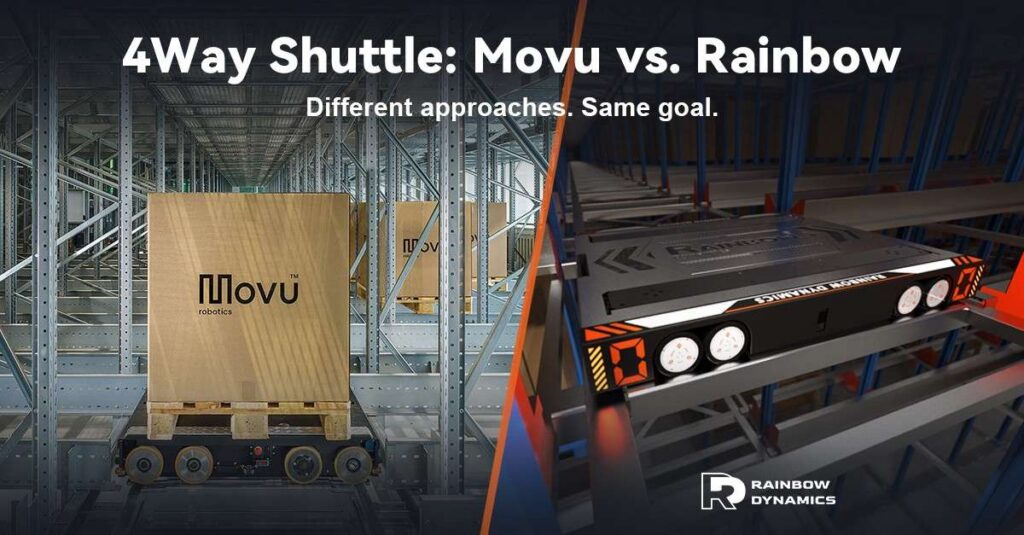
Short answer: Rainbow’s 4D Shuttle is racking-agnostic, slimmer (≈5″), uses cold-storage-friendly inductive charging, and sells only through integrators. Movu atlas is built for stow’s own racking, wider (≈8″), uses swappable batteries, and sells through integrators and direct. Choose the Rainbow 4D Shuttle for racking flexibility and integrator alignment; choose Movu atlas for a single-source bundled package. |
Four-way pallet shuttle systems are one of the fastest-growing categories in warehouse automation, replacing crane-based AS/RS with modular robots. Two names increasingly come up in the same conversation: Rainbow Dynamics’ 4D Shuttle AS/RS and Movu Robotics’ Movu Atlas (part of the Stow Group).
Both are built for high-density storage, but differ in racking flexibility, sales channel, hardware footprint, and cost. In this guide, we will break those differences down so you can evaluate both against your building and budget.
What Is a 4-Way Pallet Shuttle System?
A 4-way (or “4D”) pallet shuttle system uses autonomous, battery-powered carriers that travel along storage lanes and between levels via an integrated lift. Compared to crane-based AS/RS, these systems typically offer higher density, incremental scalability, fewer single points of failure, and flexibility across ambient, chilled, and frozen environments, coordinated by a warehouse execution layer integrated with the site’s WMS/ERP.
Both Rainbow Dynamics and Movu Robotics operate in this category, but with different engineering and business priorities underneath.
Movu Atlas: Stow-Integrated, Direct-and-Indirect Sales
Movu Atlas is a bundled racking-and-robotics platform backed by the Stow Group’s manufacturing scale, sold through a mixed channel that includes both system integrators and Movu’s own direct sales team.
How it works
Movu Robotics, a Stow Group company, engineered the Movu Atlas shuttle to run specifically on Stow’s own racking infrastructure. The shuttle navigates Stow’s rail and rack geometry via onboard sensors and a lift mechanism, with racking, conveyors, and shuttle controls built as one integrated system, simpler to commission, but not portable to another manufacturer’s racking.
The trade-offs
- Single-source racking: Atlas is designed for Stow racking; the racking portion of the project is effectively locked to one manufacturer, limiting price competition
- Wider shuttle profile: At roughly 8 inches, the shuttle body occupies more space per lane than newer-generation shuttles, leaving less usable cargo room
- Cold-storage capable: Rated to operate reliably down to –25°C, using opportunity charging with swappable batteries
- Longer implementation runway: Typically 10–12 months from PO to go-live, tied to one manufacturer’s production and installation schedule
- Dual sales model: In addition to selling through system integrators, Movu also sells directly to end customers, meaning integrators partnering with Movu can end up competing with Movu directly for the same deal
Rainbow 4D Shuttle: Racking-Agnostic, Slimmer Hardware
Rainbow Dynamics’ 4D Shuttle AS/RS takes an open, component-based approach to 4-way shuttle automation, built to give integrators flexibility on racking, hardware footprint, and commercial terms rather than locking them into a single-vendor package.
How it works
The 4D Shuttle AS/RS is built as an open platform rather than a single-vendor package. The shuttle, lift, and racking are engineered to work together, but the racking itself isn’t proprietary; it can be sourced from any qualified racking manufacturer.
Where it excels
- Racking-agnostic design: Not tied to one manufacturer, so racking can go out to competitive bid and buyers keep leverage on price
- Slimmer shuttle profile: At roughly 5 inches, the shuttle body takes up meaningfully less space per storage lane, leaving more room for cargo
- Cold-storage-ready: Lithium Iron Phosphate batteries hold full capacity down to -25°C, with inductive charging that keeps shuttles topped up without manual battery handling
- Faster time to go-live: Reaches go-live in 6–8 months from PO, well ahead of typical single-source, racking-tied platforms
- Integrator-first sales model: Sold exclusively through system integrators, positioning Rainbow Dynamics as a technology partner rather than a competitor to the integrators delivering the project
Side-by-Side Comparison: Rainbow 4D Shuttle vs. Movu Atlas
The table below stacks up both platforms across the factors that matter most when comparing 4-way shuttle systems:
| Factor | Rainbow 4D Shuttle | Movu Atlas |
| Racking freedom | Racking-agnostic, works with racking from multiple manufacturers | Purpose-built for stow racking; effectively single-source |
| Sales channel | Sold exclusively through system integrators | Sold through integrators and direct to end customers |
| More room for cargo | ≈ 5 inches of vertical space per level | ≈ 8 inches |
| Usable lane space | ~3 inches more cargo room per level vs. Movu Atlas | Less usable lane width at the same rack opening |
| Inductive charging | Inductive charging, no manual battery handling | Opportunity charging with swappable batteries |
| Cold storage fit | Purpose-built for -25°C environments; inductive charging removes exposed battery contacts in freezer conditions | Rated for -25°C environments with battery-swap charging |
| Racking sourcing | Competitive multi-bid racking sourcing | Racking tied to stow, limiting price competition |
| Manufacturing base | Asia-based manufacturing supports a lower cost structure | European/US-based manufacturing |
| More competitive total cost | Designed to be more cost-competitive | Higher cost driven by proprietary racking and manufacturing base |
| Key speed/implementation advantage | 6–8 months from PO to go-live | Around 10–12 months |
Why Racking-Agnostic Architecture Matters
When a shuttle system is engineered around one racking manufacturer’s product, that manufacturer effectively sets the price with no competing bids. A racking-agnostic system changes that dynamic in a few concrete ways:
- Competitive bidding on racking, since the buyer isn’t locked to one supplier’s catalog or pricing
- Lower total project cost, as racking becomes a negotiable line item rather than a fixed one
- Easier future expansion, without depending on one supplier’s lead times or product roadmap
- More resilience, since a supply issue with one racking vendor doesn’t stall the entire project, a factor that shows up in several of Rainbow Dynamics’ project case studies
Why Shuttle Width and Charging Method Matter in Practice
Two hardware details rarely make the headline spec sheet but have an outsized effect on day-to-day performance: how much of each storage lane the shuttle itself takes up, and how it recharges.
Shuttle Width and Usable Cargo Space
A narrower shuttle body leaves more usable width inside each storage lane. Over dozens of levels and lanes in a facility, a few extra inches per level compounds into meaningfully more usable storage volume, or the ability to fit the same capacity into a smaller footprint.
Charging Method in Cold Storage
The charging method matters more in freezer environments than in ambient warehouses. Exposed battery contacts are prone to condensation and ice buildup in sub-zero conditions. Inductive charging removes that risk entirely, which is why it’s often favored for cold-chain deployments.
Why the Sales Model Is a Bigger Deal Than It Sounds
For system integrators, a vendor’s sales model isn’t a minor detail; it shapes the entire commercial relationship. A vendor selling exclusively through integrators is, by definition, aligned with the integrator’s win. A vendor that also sells direct is, in some deals, a competitor to the same integrator it’s asking to represent its product, a tension worth clarifying before committing to a platform for a multi-year program, alongside other commercial factors covered in Rainbow Dynamics’ warehouse automation guides.
How to Decide Between the Two
Choosing a 4-way shuttle is about more than payload and speed. Before shortlisting a vendor, it’s worth asking directly:
- Can we choose the racking supplier?
- Does the shuttle maximize usable vertical space?
- Is the charging technology suited to cold environments?
- What is the total installed cost?
- Will the technology provider remain our supplier, or become our competitor?
However, with Rainbow Dynamics, the racking is open, the shuttle is compact, charging is inductive, economics are competitive, and system integrator loyalty is uncompromising.
Why Integrators and Operators Are Choosing the Rainbow 4D Shuttle
Rainbow Dynamics designs and deploys the 4D Shuttle AS/RS as part of a broader automation portfolio alongside RackBot™ goods-to-person robotics. Built around what matters most to integrators, racking-agnostic sourcing, a slimmer ≈5-inch shuttle body, inductive charging for -25°C cold storage, and a cost structure backed by Asia-based manufacturing, the 4D Shuttle is sold exclusively through system integrators, so partners never compete with us for the same deal.
Deployed across FMCG, cold storage, and 3PL environments handling loads up to 2,000 kg, it’s worth comparing against your current shortlist. Book a demo to walk through your requirements.
Conclusion
Both the Rainbow 4D Shuttle and Movu Atlas are capable 4-way pallet shuttle platforms built for high-density, cold-capable warehousing. The real differences show up beneath the spec sheet, in racking flexibility, sales channel alignment, shuttle footprint, charging method, and total cost. For operators prioritizing competitive sourcing, channel loyalty, and cost efficiency, a racking-agnostic, integrator-first platform like the Rainbow 4D Shuttle is worth a close look. Evaluate both against your specific building and commercial relationships before committing.
FAQs
How do 4-way pallet shuttle systems compare to traditional crane-based AS/RS?
Four-way systems use several smaller shuttles instead of one stacker crane per aisle. These shuttles move within lanes and between levels using a lift. This often offers higher density and fewer failure points than crane-based systems. In those systems, one crane outage can shut down an entire aisle.
What are the cost considerations when choosing between racking-agnostic and racking-specific shuttle systems?
A racking-specific item on the major project line item eliminates competitive bidding, since the racking supplier sets the price. Bidding multiple racks simultaneously in a racking-agnostic system could significantly reduce overall cost.
Why does shuttle width matter for pallet storage density?
Shuttle width affects how much usable space remains in each lane once the shuttle occupies it. A narrower shuttle leaves more room for cargo per level, which compounds across many lanes and levels into meaningfully more usable storage.
What charging method is best for 4-way shuttles operating in cold storage?
Inductive charging suits sub-zero environments better because it eliminates exposed battery contacts, which are prone to condensation and ice buildup in freezer conditions. Swappable-battery systems can work too, but introduce more manual handling at low temperatures.
Does it matter if a shuttle vendor also sells directly to end customers?
Yes, it creates the commercial linkage with the Integrators providing the work. A vendor who sells only via integrators is in step with their success, whereas one who also does direct sales could cause stress over pricing and account ownership.