
RackBot vs. AutoStore: Which Goods-to-Person System Is Right for Your Warehouse?
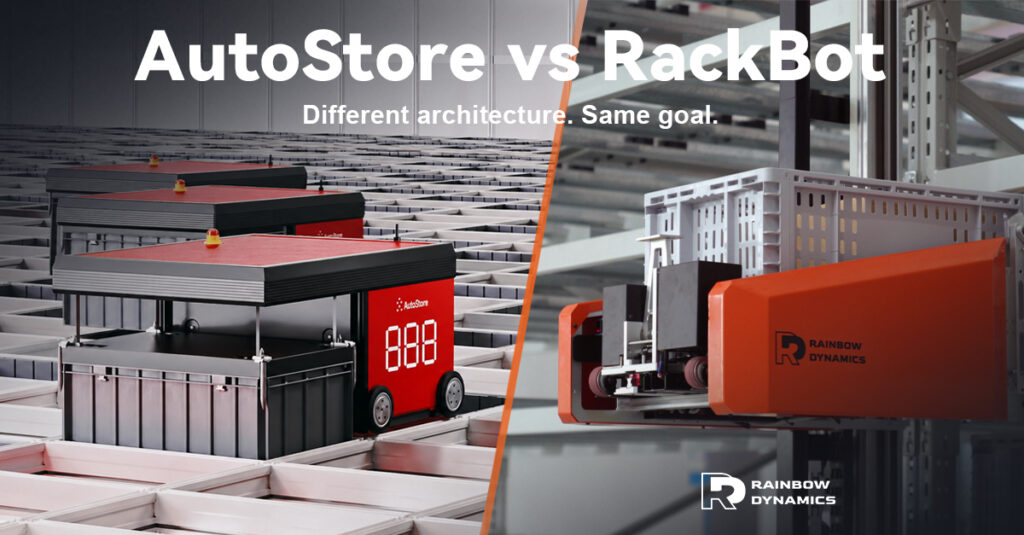
| The short answer: AutoStore stacks totes in bins inside a proprietary aluminum grid. It delivers excellent density, but retrieving a tote buried in a stack may require moving others out of the way first. RackBot stores each tote in its own rack location, up to 8.5 meters high with double-deep configurations, so retrieval doesn’t depend on digging through a pile, and it runs on standard steel racking rather than a specialized grid. |
For years, AutoStore’s cube-storage grid has been the benchmark for dense, robotic tote storage. But GTP (Goods-to-Person) is no longer a one-system market and newer platforms like RackBot challenge the idea that density has to come from stacking totes in a specialized grid. RackBot offers taller storage, more direct retrieval, standard racking, and lower cost instead.
This guide compares RackBot and AutoStore on density, retrieval speed, infrastructure, floor tolerance, and cost, so you can match the right system to your building rather than defaulting to the most familiar name.
What Is a Goods-to-Person (GTP) System?
A goods-to-person system delivers inventory to a human operator or pick station instead of the reverse. It combines a storage structure (grid, racking, or shuttle rails), robotic retrieval (bots, shuttles, or cranes), and orchestration software, typically a warehouse management system integrated with the WMS/ERP.
AutoStore and RackBot both fall under this umbrella, but achieve density and speed in fundamentally different ways.
AutoStore: The Established High-Density Benchmark
AutoStore pioneered the cube-storage concept: totes are stacked directly on top of one another inside a proprietary aluminum grid, with robots traveling on rails at the top of the grid to retrieve totes from below.
How it works
Totes are stacked in columns within a sealed aluminum grid, and robots travel across the top of the grid, lowering a lift mechanism to extract totes. To retrieve a tote buried in a stack, robots must first move the totes sitting above it. The grid itself is a precision-engineered, single-purpose structure and the system provides a mature software layer (CubeVerse™ / AutoStore Intelligence™) for layout simulation, predictive diagnostics, and digging-pattern optimization
Where it excels
Extremely dense storage for smaller, high-turnover tote-based SKUs; a mature, widely deployed platform with a large integrator network; and a strong track record in e-commerce and retail fulfillment.
The trade-offs
- Indirect retrieval: Stacked totes mean retrieving one lower in a column can require moving several above it first, a “digging” process that adds latency for less-active SKUs
- Specialized infrastructure: The aluminum grid is purpose-built and not compatible with standard racking
- Tight floor tolerance: Typically around ±3 mm/m², which can mean substantial remediation in older or brownfield buildings
RackBot: A Different Approach to Density and Retrieval
RackBot takes the core promise of goods-to-person automation – high density, low labor dependency, fast picking – and rebuilds the underlying mechanics around standard steel racking rather than a proprietary grid.
How it works
Totes are stored in individual, discrete rack locations rather than stacked columns. Robots travel vertically and horizontally within standard racking, including double-deep configurations, reaching heights of up to 8.5 meters. Because each tote occupies its own slot, retrieval doesn’t require shifting other totes out of the way first.
Where it excels
- Near-direct retrieval: Since totes aren’t stacked, RackBot can reach a target tote without first relocating other inventory
- Height without the digging penalty: At 8 meters and above, RackBot can match or exceed cube-storage density while keeping retrieval largely direct
- Racking-agnostic design: Built to work with standard steel racking rather than a proprietary structure, simplifying sourcing and future reconfiguration
- More forgiving floor tolerance: Designed for floor flatness around ±10 mm/m², reducing floor prep costs in existing buildings
- Lower overall system cost: Standard racking, relaxed floor requirements, and simpler civil infrastructure are designed to bring down total project cost versus a purpose-built grid
Side-by-Side Comparison: RackBot vs. AutoStore
The table below compares both systems across the factors that matter most in a warehouse automation decision. For deeper technical specs, Rainbow Dynamics’ white papers cover system design considerations in more detail.
| Factor | RackBot | AutoStore |
| Storage method | Totes in individual rack locations (supports double-deep) | Totes stacked in columns within an aluminum grid |
| Retrieval style | Near-direct retrieval from discrete slots | Requires moving totes above the target tote (“digging”) |
| Max practical height | Up to 8.5 m | Grid-dependent, optimized for stacking |
| Racking type | Standard steel racking, largely racking-agnostic | Proprietary aluminum grid |
| Floor flatness requirement | ≈ ±10 mm/m² | ≈ ±3 mm/m² |
| Brownfield suitability | Typically less floor prep required | Often needs significant floor remediation |
| Infrastructure complexity | Lower – standard racking components | Higher – specialized, single-purpose grid |
| Overall system cost | Designed to be lower, driven by simpler infrastructure | Higher, driven by specialized infrastructure |
| Best fit | Greenfield or brownfield sites wanting density plus flexibility and lower cost | Very high SKU counts in a compact greenfield footprint |
How to Decide Between the Two
The right system depends less on which platform is “better” and more on your building, your SKU mix, and what you’re optimizing for. Here’s how the two typically split by use case:
Consider AutoStore if
You’re building a greenfield facility with an engineered floor slab, your SKUs are small and high-turnover (minimizing digging delays), or you want an established, widely proven platform.
Consider RackBot if
You’re retrofitting an existing building and want to avoid expensive floor remediation, your operation needs faster access to specific totes, you want standard racking over a single-source grid, or cost and flexibility matter as much as density – a common scenario in fast-growing e-commerce fulfillment operations.
Why This Comparison Matters Beyond These Two Systems
AutoStore proved dense, robotic storage could transform fulfillment, but density and a proprietary stacked grid were never the same thing; they just arrived together first. RackBot reflects a broader shift toward unbundling density from AutoStore’s specific mechanics. That shift matters because:
- Buyers now have real alternatives, not just variations on the same grid concept; see it play out in these case studies
- Brownfield sites are becoming viable, where tight floor tolerances once ruled them out
- Total cost of ownership is a differentiator, not just throughput or density figures
- Racking standardization reduces vendor lock-in over the system’s lifetime
See RackBot in Action with Rainbow Dynamics
Rainbow Dynamics designs and implements RackBot™, headquartered on a unified execution software layer, and complements 4D Shuttle AS/RS pallet storage with traditional cube-storage trade-offs, system cost reduction, 24/7 support, and Robot-as-a-Service.
Whether you’re deployed across eCommerce, cold storage, FMCG, or 3PL, RackBot might suit your building better than a stacked grid. Schedule a demo to go through your floor plan and SKU profile.
Conclusion
While autoStore is a good fit for many greenfield sites, its higher capacity is offset by the taller storage, more direct retrieval, standard racking, and the high floor tolerance that RackBot does not require. The correct answer will depend on your building, SKU configuration, and balancing the speed of retrieval with cost against the actual installation floor plan. For more details, visit the Rainbow Dynamics blog.
FAQs
How do automated storage and retrieval systems compare for efficiency in warehouses?
Storage density and retrieval speed are the key to efficiency. Stacked systems are efficient for high density but may be inefficient in the case of a “buried” tote. As an alternative, a rack-based system, such as RackBot, sacrifices some density in exchange for quicker and more consistent retrieval, which is better for a broad but not as varied mix of SKUs.
What are the cost considerations when choosing a goods-to-person system?
The cost of the robot is only the beginning; storage, floor preparation, software/ WMS integration, and rolling maintenance or Robot-as-a-Service costs all add up as well. The infrastructure and civil-works cost usually decreases with standard racking and tight tolerances on the floor, such as RackBot.
How does warehouse footprint impact the choice of robotic automation?
A variety of systems fit depending on ceiling height, floor flatness, and available square footage. A tall, spacious facility works well for rack-based systems such as RackBot that scale up and not out. Systems with fewer prerequisites for the infrastructure are better suited for brownfield sites because buildings with imperfect floor slabs tend to accept a more accommodating tolerance.
What are the advantages of a modular, rack-based storage and retrieval system?
Standard steel racking is readily available and replaceable, and simpler to modify with volume changes in comparison to a structure built exclusively for that purpose. It’s also more forgiving of the existing floor conditions, and retrieval is generally more direct because totes are placed in separate locations.
What are the main differences between popular goods-to-person warehouse systems?
They differ mainly in storage method, retrieval style, infrastructure, floor tolerance, and cost. AutoStore achieves density through tote stacking in a specialized grid with tight floor requirements, while RackBot reaches comparable density through taller, rack-based storage with more forgiving tolerances and standard racking, generally at a lower cost.