
When Robots Get Attached
How Do Robots Defend Themselves Against Cyber Attacks?
At 2:00 AM, the warehouse is still moving
Most people have gone home.
But inside a modern automated warehouse, hundreds of robots continue working.
A customer order arrives from thousands of miles away. Within seconds, software systems analyze inventory, assign tasks, and coordinate robot movements across the warehouse floor.
A robot travels to the correct location.
Another robot delivers the goods.
The entire operation looks effortless.
But behind this efficiency is a question that every automation company must now answer:
What happens if a robot receives a command it should not trust?
As robotics becomes increasingly connected, robots are no longer just mechanical systems.
They are becoming part of a larger cyber-physical system (CPS) — where software decisions create real-world physical actions.
And when the digital world controls physical movement, cybersecurity becomes a business-critical requirement.
At Rainbow Dynamics, we believe secure automation cannot be added after a robot is built.
It must be engineered into the robot from the beginning.
This is the foundation of our cybersecurity philosophy:
Security-by-Design
Story 1: The Robot That Refused an Unknown Command
Defending identity with Zero Trust Architecture
Imagine an unauthorized person attempting to access a warehouse automation system.
They do not enter the facility physically.
Instead, they use stolen credentials to appear as a legitimate operator.
Their goal?
To access system functions they should never control.
In traditional systems, the question was:
“Does this user have the password?”
Modern cybersecurity requires a different question:
“Can this user prove they are trusted, and do they have permission for this specific action?”
This is the foundation of Zero Trust Architecture.
Rainbow Dynamics applies this principle throughout our robotics ecosystem.
Every user, system request, and connection must be verified before access is granted.
This includes:
- Secure authentication mechanisms
- Token-based identity verification
- Role-Based Access Control (RBAC)
- Least-privilege authorization
An operator may be able to monitor robot status.
An engineer may be able to perform maintenance.
An administrator may manage system configuration.
But no one receives more access than they need.
The robot does not simply ask:
“Did someone send this instruction?”
It asks:
“Is this instruction coming from a verified identity with the right authorization?”
A smart robot must first be a trusted robot.
Story 2: The Robot That Questioned the Data It Received
Protecting the integrity of every instruction
Inside an automated warehouse, thousands of digital decisions happen every minute.
Move this pallet.
Retrieve this inventory.
Change this task sequence.
Coordinate with another robot.
These instructions travel through complex software systems before reaching physical machines.
Now imagine one small change.
A location is modified.
A command is altered.
A data request is manipulated.
The robot may still execute the instruction perfectly.
But the instruction itself may no longer be correct.
This is the challenge of data integrity.
Cyber attackers do not always need to take control of a system.
Sometimes, they only need to change what the system believes is true.
Rainbow Dynamics addresses this challenge through multiple layers of protection.
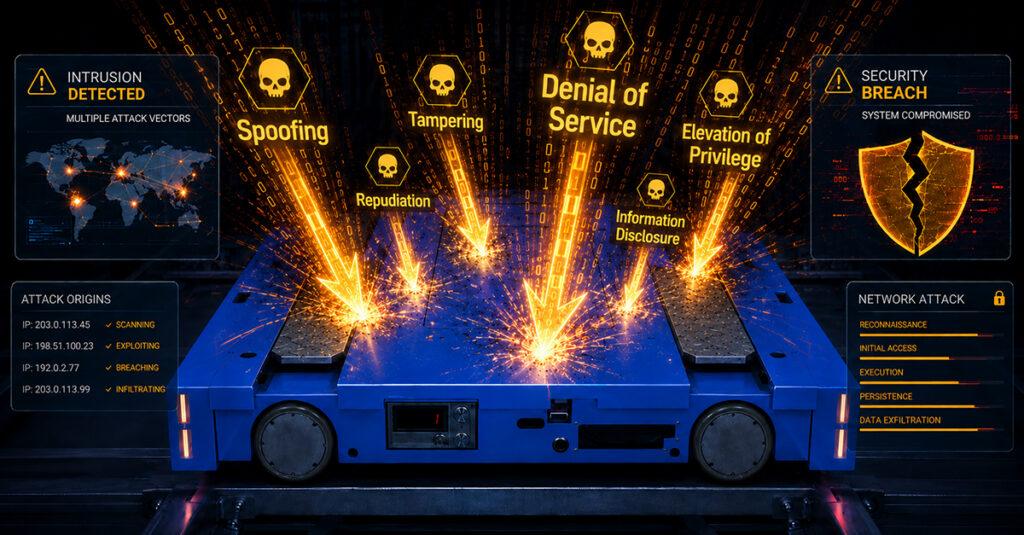
Using threat modeling frameworks such as STRIDE, we analyze how attackers could attempt to manipulate communication, exploit vulnerabilities, or compromise system trust boundaries.
Our defense includes:
- Secure communication channels
- API protection
- Input validation
- Protection against injection attacks
- Controlled access to critical system functions
The objective is simple:
A robot should only act on information that has integrity.
Because in automation:
Digital trust creates physical reliability.
Story 3: The Robot That Could Explain What Happened
Building accountability through operational visibility
Now imagine something unusual happens.
A warehouse manager notices that a system setting has changed.
A robot behaved differently from expected.
A workflow was interrupted.
The first question is not:
“How do we restart the system?”
The first question is:
“What happened?”
In a complex robotic environment, answers matter.
Who made the change?
When did it happen?
Which system initiated the action?
Without visibility, even the strongest security systems become difficult to manage.
This is why Rainbow Dynamics focuses on operational traceability.
Important system activities are recorded through structured audit mechanisms, creating a clear history of events.
The system can capture:
- User identity
- Timestamp
- Source information
- Operational actions
This supports investigation, root cause analysis, and continuous improvement.
A secure robot is not only one that can prevent an attack.
It is one that can tell its own story.
Story 4: The Robot That Kept Moving
Protecting availability in mission-critical operations
For a warehouse processing thousands of orders, downtime is not simply a technical inconvenience.
It affects customers.
It affects supply chains.
It affects business performance.
Cyber attackers understand this.
Sometimes their objective is not to steal information.
Sometimes their goal is to stop operations.
This is why cybersecurity must also protect availability.
Rainbow Dynamics designs automation systems with resilience in mind, including mechanisms to manage abnormal system behavior, protect critical resources, and maintain stable operations.
A secure automation system must not only defend itself.
It must continue performing when challenged.
Story 5: The Robot That Knew Its Limits
Preventing unauthorized privilege escalation
In a large automation environment, many people interact with the system.
Operators.
Engineers.
Maintenance teams.
Administrators.
But not everyone should have the ability to change everything.
A common cybersecurity failure occurs when users gain access beyond their intended role.
This is known as privilege escalation.
Rainbow Dynamics addresses this through strict permission management and separation of responsibilities.
The principle is simple:
The right person. The right access. The right time.
Nothing more.
The Future of Robotics Is Built on Trust
Robotics is entering a new era.
Machines are becoming more intelligent.
Warehouses are becoming more automated.
Operations are becoming more connected.
But the more connected robots become, the more important trust becomes.
At Rainbow Dynamics, cybersecurity is not an additional feature.
It is a foundation.
Through:
- Security-by-Design
- Zero Trust Architecture
- Threat Modeling
- Defense-in-Depth
we are building automation systems designed not only to move faster — but to operate with confidence.
Because the most advanced robot is not simply the one that works the fastest.
It is the one customers can trust.
About the Authors
Alfred Chen and Sumio Tanaka are leaders at Rainbow Dynamics, working with global customers to develop intelligent robotics solutions for the future of logistics.
Together, they are building a future where automation, intelligence, and cybersecurity move forward as one.